
The Reconciliation Tax: What It Really Costs When Your Numbers Don't Agree
The cost nobody budgets for
Most finance leaders can tell you their close timeline to the day. Fewer can tell you how much strategic capacity they lose to data validation. The reconciliation tax does not appear on any P&L. It shows up in delayed board materials, in forecasts that arrive too late to act on, in talent attrition among analysts who joined to do meaningful work and spend their weeks matching spreadsheets.
Think about the composition of your close cycle. How much of that time involves creating new insight? And how much involves confirming that data from one system matches data from another?
For most organizations, the ratio is sobering. The majority of close time goes to proving, not explaining. Teams assemble their version of the truth from disparate sources rather than working from a single version that already exists.
One enterprise put concrete numbers on the problem: a process that consumed a week of effort across 100 Excel files was eventually reduced to 30 minutes and a few clicks. That did not happen because the team worked harder. It happened because the architecture underneath changed.
Where the reconciliation burden comes from
The root cause is architectural. Most enterprise financial systems were built around sub-ledgers. Accounts payable in one place. Accounts receivable in another. General ledger somewhere else. Intercompany transactions layered on top. Each sub-ledger maintains its own balances, its own timing, its own logic.
The close process, then, becomes reconstruction. Finance teams reconcile across these sub-ledgers, adjust for timing differences, manually consolidate entities, and validate that the resulting picture is accurate. Every step introduces risk. Every manual touch is a potential error. And the more entities, currencies, and jurisdictions involved, the heavier the tax becomes.
This is not a people problem. Your finance team is not slow. The architecture is creating work that does not need to exist.
A single-ledger system operates differently. When every entry is made once and the accounts are always in balance, reconciliation between sub-ledgers disappears. There is nothing to reconcile. The consolidated view is not assembled at period end. It exists continuously. Drill-down from any summary to any source document is a navigation step, not a data extraction project.
The result: organizations using this approach report month-end close times up to 40% faster. Not by automating the reconciliation. By eliminating the need for it entirely.
What your team does with the time back
The real value is not the faster close. The faster close is a prerequisite for something more significant: shifting your finance function from a proving organization to an explaining organization.
When your team stops spending the first week of every month validating data, the nature of their work changes. Controllers become advisors. Analysts become strategists. The finance function moves from back-office reporting to front-line decision support.
That shift matters because the questions facing CFOs in 2026 are not accounting questions. They are business questions. Should we enter this market? Can we absorb this cost increase without repricing? What happens to cash flow if two major customers delay payment simultaneously? These questions require financial judgment, not financial reconciliation. But judgment takes time, and time is exactly what the reconciliation tax consumes.
Organizations that have freed their teams from the proving cycle report something beyond productivity gains. They report higher retention among senior finance professionals. People who chose finance as a career because they wanted to analyze and advise, not because they wanted to match spreadsheets, stay longer when their work reflects that ambition.
From proving to explaining
The shift does not require replacing your entire technology stack. It requires rethinking one foundational layer: where your financial data lives and how it stays consistent.
If your ledger architecture creates reconciliation work, every tool you build on top inherits that burden. Your dashboards display reconciled (not real-time) data. Your forecasts start with a data collection exercise. Your AI initiatives run on data that was accurate last week but may not reflect today.
If your ledger architecture eliminates reconciliation by design, those same tools become genuinely useful. Dashboards show what is happening now. Forecasts build on data you trust without validating first. AI models work with clean, unified, always-current information.
The difference is not incremental. It is structural. And it flows through every decision your organization makes.
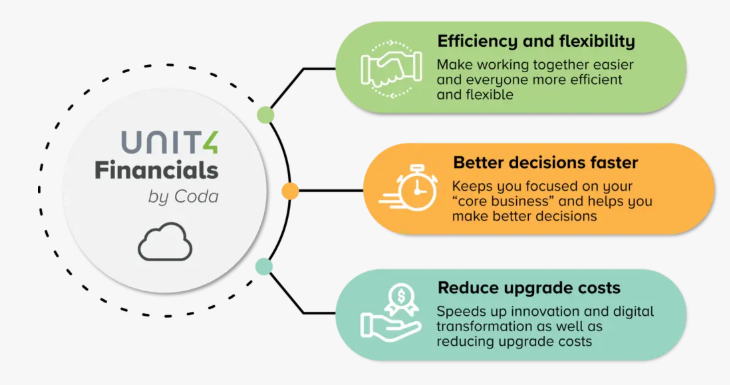
Unit4 Financials by Coda was built on a single-ledger architecture over 45 years ago, specifically so finance teams could stop proving and start explaining. See how it works.

Sign up to see more like this
Blogs recommandés
septembre 8, 2026 8 minutes de lecture
L'explicabilité : le nouveau facteur de différenciation de la finance propulsée par l'IA
En savoir plus
juin 23, 2026 4 minutes de lecture
Pourquoi votre environnement Financials by Coda a besoin de la solution FP&A pour être complet
En savoir plus
juin 18, 2026 4 minutes de lecture
Vos équipes FP&A ont mieux à faire que de chercher des réponses : l'IA peut les aider
En savoir plus
Blogs populaires
juin 16, 2026 7 minutes de lecture
Comment les directeurs financiers doivent utiliser l'IA pour la planification stratégique en 2026
En savoir plus
juillet 1, 2026 6 minutes de lecture
25 prompts d'IA concrets que tout DAF devrait utiliser en 2026
En savoir plus
août 13, 2026 6 minutes de lecture
Comment l'IA native en FP&A met fin au cycle export-réconciliation (et pourquoi cela change tout)
En savoir plus
septembre 22, 2026 4 minutes de lecture
Mesurer le succès de l'IA en finance : des résultats concrets, pas des démos
En savoir plus
juillet 16, 2026 5 minutes de lecture
La finance sous pression : comment l'IA redéfinit le rôle du directeur financier
En savoir plus
juin 24, 2026 10 minutes de lecture
Dix modèles de prompts IA indispensables aux directeurs financiers pour la planification
En savoir plus
juillet 16, 2026 5 minutes de lecture
La finance sous pression : comment l'IA redéfinit le rôle du directeur financier
En savoir plus
Ne manquez pas les derniers blogs Unit4
Inscrivez-vous pour recevoir des analyses sectorielles et du contenu exclusif